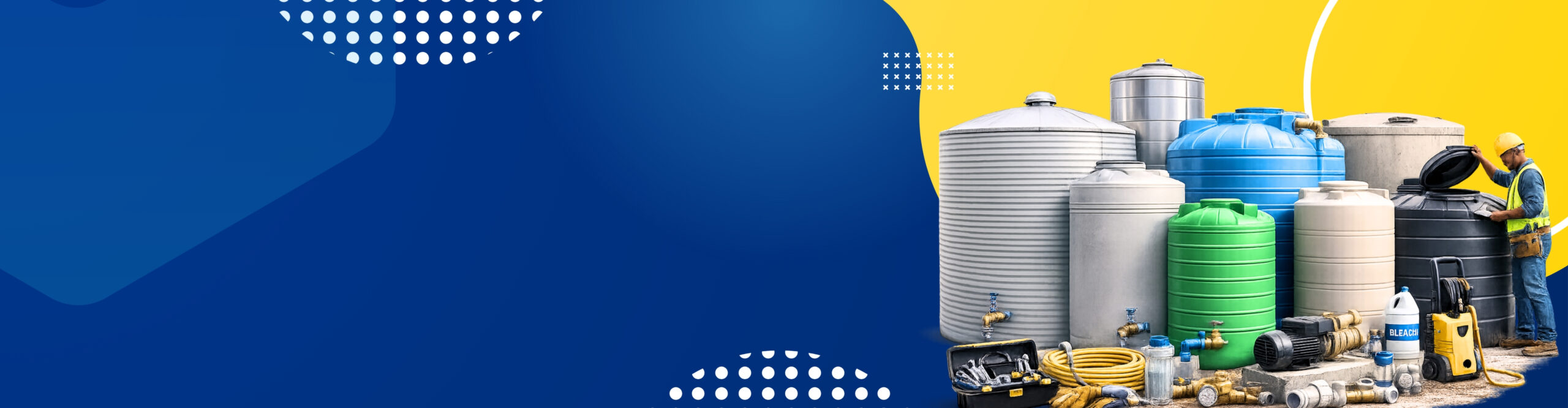
Water tanks are the backbone of reliable water supply for homes, farms, and commercial projects, yet they’re often an afterthought in project planning. Choosing the wrong size or material can lead to frequent shortages, pump failures, contamination, and unnecessary costs over the tank’s lifetime.
How to Choose the Right Water Tank Size
1. Understand your daily water demand
Start by estimating how much water you use in a day. For domestic users, this typically includes drinking, cooking, bathing, cleaning, toilet flushing, and outdoor use like gardening or car washing. As a simple guide:
- 1–2 people: about 500–1,000 litres per day
- 3–4 people: about 1,000–2,000 litres per day
- 5–6 people: about 2,000–3,000 litres per day
- Larger homes / small businesses: 3,000–5,000+ litres per day, depending on operations
For commercial, agricultural, or industrial projects, add process water, equipment cleaning, and staff usage into your daily estimate.
2. Decide how many days of storage you need
Your ideal tank capacity depends on how reliable your water source is.
- Areas with regular municipal supply: plan for 1–2 days of storage.
- Areas with frequent outages or low pressure: plan for 3–5 days of storage or more.
- Borehole / tanker-dependent properties: often need higher storage for safety and cost efficiency.
A practical sizing formula is:
Tank capacity ≈ daily consumption × days of storage × safety factor (1.1–1.2 for buffer).
3. Check space and structural constraints
Even if you know the volume, the tank must physically fit your site.
- Rooftop: check slab load-bearing capacity and available footprint, and keep safe clearances for access.
- Ground: ensure enough level area for the tank diameter/length plus pipework.
- Underground: consider excavation room, vehicle loads above, and safe access points.
Tank Materials: Which One Is Right for You?
1. Plastic (HDPE / LLDPE / other polyethylene)
Polymer tanks are now the most common choice for domestic and light commercial use.
Advantages:
- Lightweight and easy to transport and install, including on rooftops.
- Corrosion-resistant, unlike bare steel or poorly treated concrete.
- Good for potable water when manufactured with food-grade materials.
- Available in many sizes, shapes, and colours to suit space and aesthetics.
Considerations:
- Must be UV-stabilised to withstand sun exposure and avoid premature ageing.
- Needs proper support (stable, level base) to avoid deformation over time.
COBEF’s expertise in HDPE and LLDPE production helps ensure strong, impact-resistant tanks that can stand up to Nigeria’s climate and project demands.
2. Concrete tanks
Concrete tanks are often used for large or underground storage.
Advantages:
- Very robust and durable when built correctly.
- Less affected by temperature swings for underground applications.
Considerations:
- Heavy and labour-intensive to build or relocate.
- Risk of cracking and leakage if not designed or maintained properly.
- May require internal linings or coatings for potable water.
3. Steel tanks (mild or galvanised)
Steel tanks are more common in industrial or large-scale settings.
Advantages:
- High strength, can be manufactured in bolted or welded designs for large volumes.
- Suitable where high structural loads or elevated structures are required.
Considerations:
- Prone to corrosion if not protected by coatings or liners.
- Often higher maintenance cost than polymer tanks in harsh environments.
4. Fibreglass (FRP / GRP) tanks
Fibreglass tanks are used where chemical resistance or specific engineering properties are needed.
Advantages:
- Good resistance to many chemicals and to corrosion.
- Useful in industrial, treatment, and specialised applications.
Considerations:
- Typically higher upfront cost.
- Installation and repairs often need specialised skills.
Placement options
- Rooftop tanks
- Pros: rely on gravity for water pressure, easy to integrate into existing pumping systems.
- Consider: structural capacity of slab, safe access for cleaning, wind loads.
- Ground-level tanks
- Pros: easier installation and maintenance, can accommodate larger volumes.
- Consider: need a pump and possibly a pressure tank for consistent pressure.
- Underground tanks
- Pros: save surface space and keep water cooler and darker (less algae).
- Consider: waterproofing, structural design against soil and traffic loads, safe access covers.
Repair vs Replacement: When to Upgrade Your Tank
Repairable Problems
- Leaks at fittings that can be fixed by resealing or replacing connectors.
- Small surface cracks that can be patched, if they are not structural.
- Faulty valves, float switches, or level sensors.
When to Replace
- Significant bulging or deformation of the tank walls or base.
- Recurring leaks that keep returning after repairs.
- Severe UV damage, brittle plastic, or internal surface breakdown.
- Contamination issues that persist even after thorough cleaning and disinfection.
Upgrading to a certified, quality-controlled polymer tank system, combined with compatible PVC or HDPE piping, can dramatically reduce maintenance issues and water losses in the long term.
How COBEF Can Support Your Project
COBEF International manufactures polymer-based products like HDPE tanks, PVC pipes, fittings, and related components under stringent ISO and SON-certified quality systems. With a modern factory, in-house testing lab, and experience across domestic, agricultural, and major water infrastructure projects, COBEF can guide clients from tank sizing and product selection to long-term performance support.
Contact Cobef
Contact us to source ISO-certified PVC, HDPE pipes, water tanks, suction hoses, and turnkey piping projects for construction, agriculture, or water supply in Nigeria
Head Office:
Km 17 Port Harcourt/Aba Express Way
P.O. Box 2769
Port Harcourt, Rivers State, Nigeria
Call Us:
+234 813 576 3467
+234 811 734 4533
+234 902 149 3237
Email:
pawantekchandani@hotmail.com
pawan.tekchandani@cobefinternationalltd.com
